
Walk into Udupi on any morning, and you’ll hear it before you see it: the low chant of Sanskrit prayers drifting past coconut groves and coffee shops. This is a temple town, and its heart is the Sri Krishna Temple, one of the most visited pilgrimage sites in coastal Karnataka. Millions come here every year, not just to pray, but to witness a form of worship you won’t find anywhere else in India.
Quick Info: Udupi Sri Krishna Temple
| Temple Name | Udupi Sri Krishna Temple (Sri Krishna Matha) |
| Deity | Lord Krishna (as Bala Krishna) |
| Location | Udupi, coastal Karnataka, India |
| Founded By | Sri Madhvacharya, 13th century CE |
| Darshan Timings | 4:30 AM – 9:30 PM daily (rituals pause the queue at intervals) |
| Entry Fee | Free; a single queue serves all visitors |
| Best Time to Visit | October to March, with October–February as peak season |
| Nearest Railway Station | Udupi Railway Station, about 3 km away |
| Nearest Airport | Mangaluru International Airport, about 60 km away |
| Famous For | The Kanakana Kindi window, Paryaya festival, Ashta Mathas |
The History of Udupi Sri Krishna Temple
The story of this temple begins with Madhvacharya, a 13th-century saint and philosopher who founded the Dvaita school of Vedanta. He built the temple around 1238 CE, and it grew into far more than a shrine. Madhvacharya turned it into a center of Vedic learning, and that role continues today through the Sri Krishna Matha, the monastic complex that surrounds the sanctum.
According to temple legend, Madhvacharya once rescued a ship caught in a storm off the Malpe coast. In gratitude, the ship’s captain offered him a large lump of gopichandana clay. When Madhvacharya broke it open, he found a stone idol of Bala Krishna, the child form of Lord Krishna, said to have originally been worshipped by Krishna’s wife, Rukmini. He carried the idol to Udupi and installed it in the temple, where it remains today.
To manage the temple and carry forward his teachings, Madhvacharya established eight monasteries known as the Ashta Mathas. These eight mathas still run the temple’s daily affairs, taking turns in a rotation called the Paryaya, which changes hands every two years in a grand public ceremony.
The Legend of the Kanakana Kindi
Every visitor to Udupi hears this story, and it explains the temple’s most distinctive feature. In the 16th century, a poet-saint named Kanakadasa traveled to Udupi to seek Krishna’s blessings. Temple authorities turned him away at the door because of his caste.
Kanakadasa didn’t leave. He sat behind the temple and sang his devotion instead. Moved by his faith, Lord Krishna is said to have turned the idol to face west, away from the main entrance, and a small window cracked open in the wall behind it. Through that window, Kanakadasa finally received his darshan.
That window still exists. Devotees call it the Kanakana Kindi, and it holds a silver-plated grille with nine openings, known as the Navagraha Kindi. To this day, no one views the idol of Krishna directly. Every visitor, regardless of who they are, looks through the same nine holes in the same wall. What began as an act of exclusion became the temple’s defining symbol of equality.
Architecture and Sacred Spaces Inside the Complex
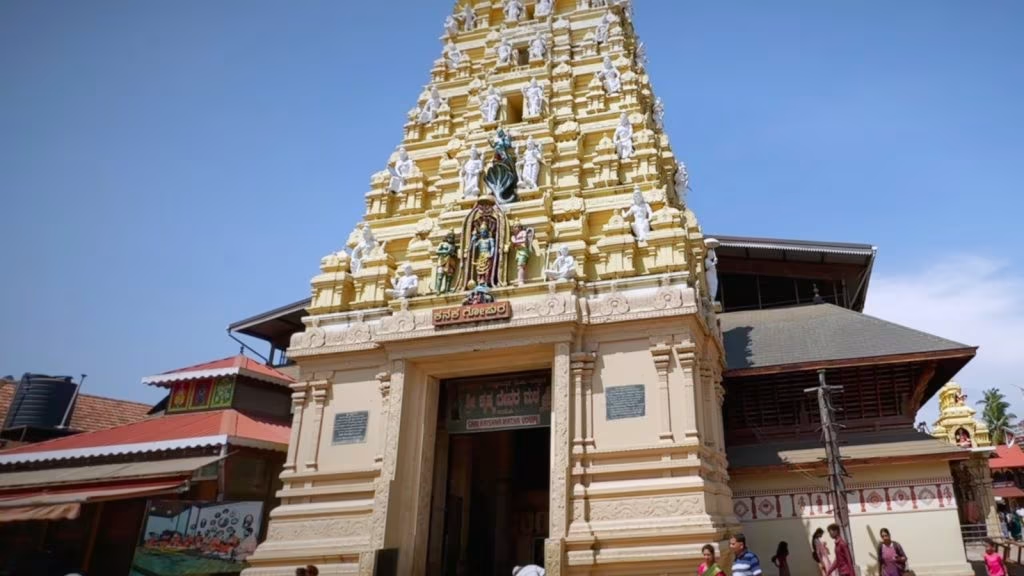
The temple complex blends Dravidian, Hoysala, and Vijayanagara architectural styles, built up over centuries by successive mathas. The main entrance, the Rajagopuram, rises above the street with detailed stone carvings drawn from Hindu mythology.
Chandrasala Hall and the Navagraha Kitiki
Inside, the Chandrasala Hall houses the famous nine-holed window. The hall’s wooden ceilings and carved pillars reflect the craftsmanship of coastal Karnataka temple builders, and the space stays busy with devotees queuing for darshan through the day.
Madhwa Sarovar
Just outside the main shrine sits the Madhwa Sarovar, a temple tank where pilgrims bathe before entering. Many visitors take a moment here to reflect before joining the darshan queue.
Ashta Mathas
Surrounding the main temple, the eight mathas each maintain their own quarters, kitchens, and prayer halls. Visitors can walk between them, and during the Paryaya festival, the changeover procession passes right through this stretch of the complex.
Daily Rituals, Sevas, and the Anna Prasada
The temple day starts before sunrise. Priests perform the first aarti in the early hours, and a conch shell sounds out around 5 a.m, a moment many visitors plan their trip around. Rituals continue through the day, with breaks between sessions for temple maintenance and preparation.
One tradition stands out: the temple’s Anna Prasada, a free meal served daily to thousands of visitors regardless of background or income. The kitchen operates on a scale that’s hard to grasp until you see it, feeding pilgrims, students, and travelers side by side. If you visit around midday, don’t skip this. It’s as much a part of the temple’s identity as the darshan itself.
Best Time to Visit Udupi Sri Krishna Temple
October to March works best for most travelers. The weather stays cool and comfortable, and this window also covers major festivals like Krishna Janmashtami, Makar Sankranti, and the Rathotsava chariot procession.
- October to February: Peak season, pleasant weather, festival season overlaps
- March to May: Warmer days, but thinner crowds and quieter mornings for darshan
- June to September: Monsoon season, lush surroundings, but limited outdoor sightseeing
If you want a peaceful darshan without the crowds, arrive between 5 and 7 AM on a weekday. Weekends and festival days draw significantly larger queues.
How to Reach Udupi Sri Krishna Temple
By Air
Mangaluru International Airport is the nearest airport, roughly 60 km from Udupi. From there, cabs and buses run regularly along the coastal highway.
By Rail
Udupi Railway Station sits about 3 km from the temple and connects to major cities including Bengaluru, Mumbai, Mangaluru, and Thiruvananthapuram. Autos and cabs are readily available outside the station.
By Road
KSRTC and private buses connect Udupi to Bengaluru, Mangaluru, Mysuru, Goa, and Pune. The temple itself sits within walking distance of Udupi’s city center, so once you’re in town, you won’t need transport to reach it.
Nearby Places to Visit
A trip to the Sri Krishna Temple pairs easily with a few other coastal Karnataka destinations, all within an hour’s drive.
- Malpe Beach: A popular beach roughly 6 km away, known for its ferry to St. Mary’s Island
- St. Mary’s Island: Famous for its hexagonal basalt rock formations, reachable by boat from Malpe
- Anegudde Vinayaka Temple: A hilltop Ganesha shrine about 25 km from Udupi
- Kapu Beach: A quieter beach with a lighthouse, good for a sunset stop
Visitor Etiquette and Tips
- Dress modestly. Men may need to remove their shirts before entering the inner sanctum, and women should wear full-length clothing.
- Photography is restricted inside the main shrine, so keep your phone away near the sanctum.
- Footwear stays outside the temple, so wear something easy to slip off.
- Expect a single queue for everyone. The temple doesn’t offer a paid fast-track darshan.
- Try to visit during the Paryaya festival if your dates align. It’s a rare, colorful spectacle.
Conclusion
Udupi Sri Krishna Temple is one of Karnataka’s most cherished pilgrimage sites, where history, devotion, and tradition come together. Whether you visit for a peaceful darshan, the inspiring Kanakana Kindi, or the temple’s vibrant festivals, the experience offers a deeper connection to the spiritual and cultural heritage of coastal Karnataka.
FAQ’s
What are the darshan timings at Udupi Sri Krishna Temple?
The temple opens at 4:30 AM and closes at 9:30 PM daily. Darshan pauses briefly between rituals, so plan around the early morning or evening hours for the smoothest visit.
Why is the idol viewed through a window instead of directly?
This tradition traces back to the legend of Kanakadasa, a devotee denied entry to the temple. The idol is said to have turned to face him through a wall opening, now known as the Kanakana Kindi, and every visitor since has viewed the deity through that same nine-holed window.
Is there an entry fee for Udupi Sri Krishna Temple?
No. Entry and darshan are free for everyone, and the temple maintains a single queue rather than offering paid special darshan.
What is the Paryaya festival?
Paryaya is a biennial ceremony in which management of the temple passes from one of the eight Ashta Mathas to the next. It draws large crowds and features processions, rituals, and cultural events across Udupi.
How far is the temple from Mangaluru?
The temple sits about 60 km from Mangaluru International Airport, roughly a 90-minute drive along the coastal highway.
What should I wear to the temple?
Choose modest, full-length clothing. Men may be asked to remove their shirts before entering the inner sanctum, and sleeveless or short outfits aren’t appropriate for women.
Can I get free food at the temple?
Yes. The temple serves Anna Prasada, a free meal, to thousands of visitors every day in its dining hall, regardless of who they are.