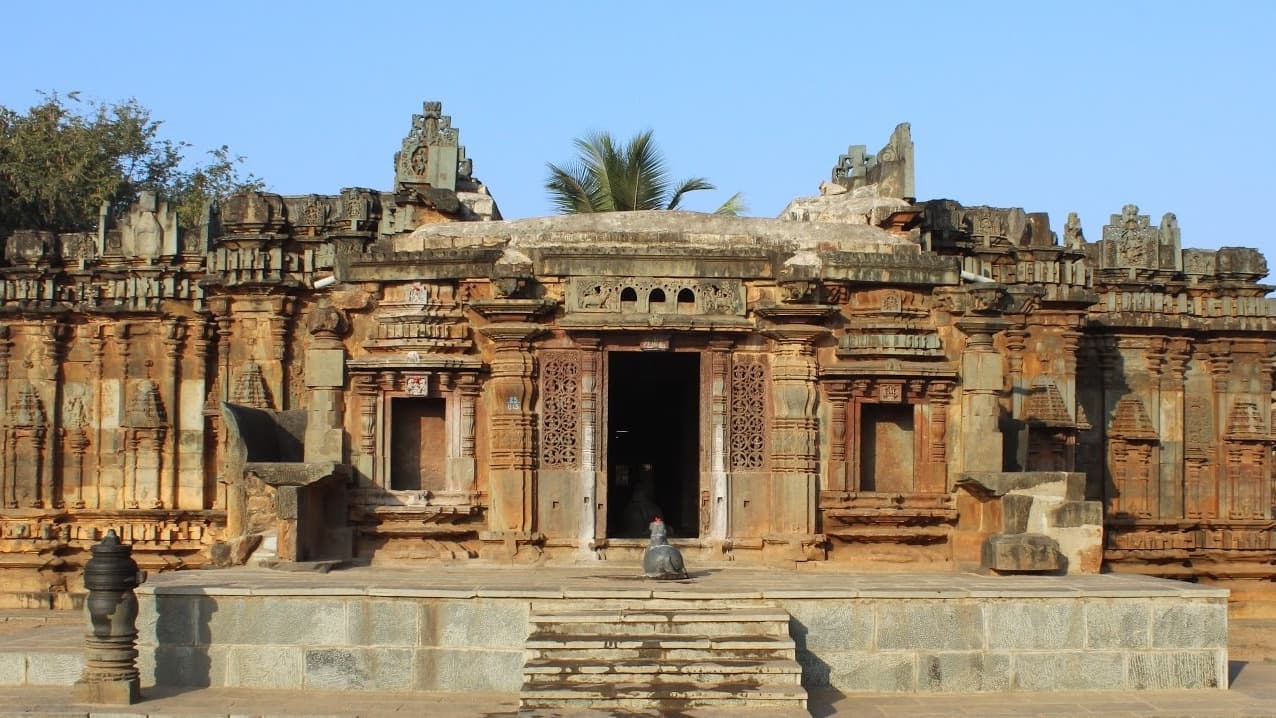
Most travelers rush past Unkal on their way between Hubballi and Dharwad, chasing the lake views and missing what sits quietly beside them. On the banks of Unkal Lake stands a 900-year-old temple that architecture students study and casual visitors overlook: the Chandramouleshwara Temple. It never got finished. Yet what its Chalukyan builders left behind still ranks among Karnataka’s finest examples of temple stonework.
Quick Info: Chandramouleshwara Temple
| Temple Name | Sri Chandramouleshwara Temple |
| Deity | Lord Shiva, worshipped as a Chaturmukha Linga |
| Location | Unkal, Hubballi-Dharwad, Karnataka |
| Built By | Chalukya dynasty (Kalyana Chalukyas), c. 11th–12th century CE |
| Architectural Style | Chalukyan, sandhara plan with four cardinal entrances |
| Temple Timings | 6:00 AM to 11:00 AM and 5:00 PM to 7:30 PM |
| Entry Fee | Free |
| Best Time to Visit | October to February |
| Nearest Railway Station | Hubballi Junction, about 5 km away |
| Protected By | Archaeological Survey of India |
Who Built It, and When
Records point to the Kalyana Chalukyas, a dynasty that ruled large parts of Karnataka between the 6th and 12th centuries. Inscriptions found in Unkal village date to the 12th century, and scholars who study Chalukyan architecture place the temple’s construction around the 1080s CE, under a court official named Bommanna Dandanayaka. That puts it in the same architectural family as the celebrated temples of Badami, Aihole, and Pattadakal, though far fewer people know its name.
The temple has no gopuram, unlike the towering entrance gates you’d find at Krishna temples along the coast. Chalukyan builders worked differently. They favored low, spreading structures with detailed stone carving over height, and Chandramouleshwara follows that pattern closely.
The Legend of a Single Night
Ask a local how the temple came to be, and you’ll likely hear a story rather than a date. Local lore claims the Chalukya king wanted to display his kingdom’s wealth and craftsmanship to rival rulers, so he ordered a team of anonymous sculptors to build the temple in a single night.
The artisans worked until dawn, but they couldn’t finish. When sunlight broke over Unkal, they downed their tools and vanished, leaving several sections incomplete. That’s the story locals tell for why the temple looks unfinished today, with mandapas that stop mid-structure and carvings that trail off. Historians read it differently. They see a temple that simply lost royal patronage and funding as Chalukyan power declined, but the legend has outlived the explanation.
A Design You Won’t Find Elsewhere in Karnataka
Step back and look at the temple from outside, and its layout stands out immediately. Chandramouleshwara follows a square-cross plan with an entrance on each of the four cardinal sides, a configuration Sanskrit architectural texts call sandhara. Most temples from this era open in one direction, toward the rising sun. This one opens in four.
At the center, the shrine originally held a Chaturmukha Linga, a four-faced representation of Shiva meant to be approached and viewed from every direction. The design isn’t a decorative flourish. It reflects a specific theological idea: that Shiva faces every direction at once, and worship shouldn’t be confined to a single approach.
What Survives Today
Only the central shrine remains fully intact. The surrounding mandapas, halls that once extended outward from the sanctum, stand partially built or eroded by time. Two large Shivalingas occupy the inner sanctum, flanked by Nandi statues at the entrance, Shiva’s bull vehicle rendered in the same weathered black stone as the rest of the structure.
The Carvings
Despite its incomplete state, the surviving stonework holds up. Pillars carry detailed relief work, and door frames show the kind of intricate ornamentation Chalukyan sculptors were known for. Photography enthusiasts and architecture students visit specifically for this detail work, often spending far longer here than the temple’s modest size suggests.
Why Shaivites Still Visit
Beyond its architectural pedigree, Chandramouleshwara holds a real place in local devotion. The name itself carries meaning: Chandra refers to the moon, and Mauleshwara points to Shiva as the one who wears it on his crown. Devotees see the temple as a direct invocation of this form of Shiva, and the site has drawn worshippers from villages around Unkal for centuries, long after its royal patrons disappeared.
The temple lost prominence for a stretch after the Chalukya dynasty declined, and parts of the complex fell into disrepair. Local Shaiva communities kept it functioning at a minimal level even through those quieter centuries, and restoration work under the Archaeological Survey of India later brought the site back into wider notice. That continuity, worship carrying on quietly while empires rose and fell around it, is part of what draws history-minded visitors here rather than to more polished, better-known temples.
Visiting the Temple Today
The Archaeological Survey of India maintains Chandramouleshwara Temple as a protected monument, which keeps the site in reasonably good condition despite its age. It functions both as a heritage site and an active place of worship, so you’ll find local devotees performing puja alongside visitors documenting the architecture.
Mornings between 6 and 11 AM see the steadiest footfall from worshippers, while the temple reopens for evening prayers from 5 to 7:30 PM. Entry costs nothing, and there’s no separate ticket for photography, though visitors should stay respectful near the active shrine areas.
Best Season to Visit
October through February brings Hubballi-Dharwad’s most comfortable weather, with cool mornings that make the short walk around the temple grounds pleasant rather than sticky. Summer months climb into uncomfortable heat by midday, so if you’re visiting between March and May, plan for an early start.
Getting to Unkal
Hubballi Junction Railway Station sits about 5 km from the temple and connects to major routes across Karnataka and neighboring states. From the station, autos and cabs reach Unkal within 15 to 20 minutes depending on traffic. Hubballi Airport, roughly 10 km away, runs regular domestic flights and works well if you’re coming from Bengaluru or Mumbai. The temple sits just off the Hubli-Dharwad highway, so it’s an easy stop if you’re driving between the two cities.
Round Out Your Visit
Because Chandramouleshwara sits right on Unkal Lake, most visitors pair the two in a single trip. The lake offers a quiet walking path and a popular spot for an evening break after the temple visit, with the water often calm enough for a decent reflection shot of the surrounding hills. A short drive away, the Bhagavad Gita Jnana Loka gallery in Dharwad houses artwork inspired by the scripture’s teachings, a good stop for anyone interested in the region’s spiritual art beyond stone architecture.
History enthusiasts can extend the day with the old Dharwad Fort or the Karnataka University campus, both of which sit within a comfortable drive of Unkal, and together they round out a fuller picture of the twin cities’ layered past.
A Few Things to Keep in Mind
- Wear comfortable footwear. Uneven stone flooring around the mandapas needs careful footing.
- Visit during pooja hours if you want to see active rituals rather than just the architecture.
- Carry water. The site has minimal shade once you’re away from the main shrine.
- Combine your visit with Unkal Lake for a relaxed half-day outing rather than a rushed stop.
- Respect the ASI protection status. Avoid touching or leaning on carved surfaces.
Conclusion
Chandramouleshwara Temple is more than an ancient Shiva shrine. It is a remarkable example of Chalukyan craftsmanship, where unfinished stonework tells a story as compelling as the carvings themselves. Whether you come to admire its rare four-entrance design, explore its centuries-old legends, or seek a quiet place of worship, the temple offers a glimpse into Karnataka’s rich architectural and spiritual heritage. Pair your visit with the peaceful surroundings of Unkal Lake, and you’ll discover a lesser-known destination that rewards those willing to look beyond the usual tourist trail.
FAQ’s
How old is Chandramouleshwara Temple?
Historians date the temple to roughly the 1080s CE, based on nearby inscriptions and its architectural style, making it close to 900 years old.
Why does the temple look unfinished?
Local legend says artisans built it in a single night and ran out of time before sunrise. Historians attribute the incomplete mandapas to a loss of royal funding as Chalukyan power declined.
What makes the temple’s design unusual?
It follows a sandhara plan with four entrances, one on each cardinal direction, built around a Chaturmukha Linga meant to be worshipped from every side. Most temples of this era open in a single direction.
Is there an entry fee?
No. Entry to Chandramouleshwara Temple is free, and there’s no separate charge for photography.
What are the temple timings?
The temple stays open from 6:00 AM to 11:00 AM and again from 5:00 PM to 7:30 PM daily.
How do I get to the temple from Hubballi?
The temple sits about 5 km from Hubballi Junction Railway Station. Autos and cabs cover the distance in 15 to 20 minutes.
What else can I see nearby?
Unkal Lake sits right beside the temple, and the Bhagavad Gita Jnana Loka gallery, Dharwad Fort, and Karnataka University campus all lie within a short drive.