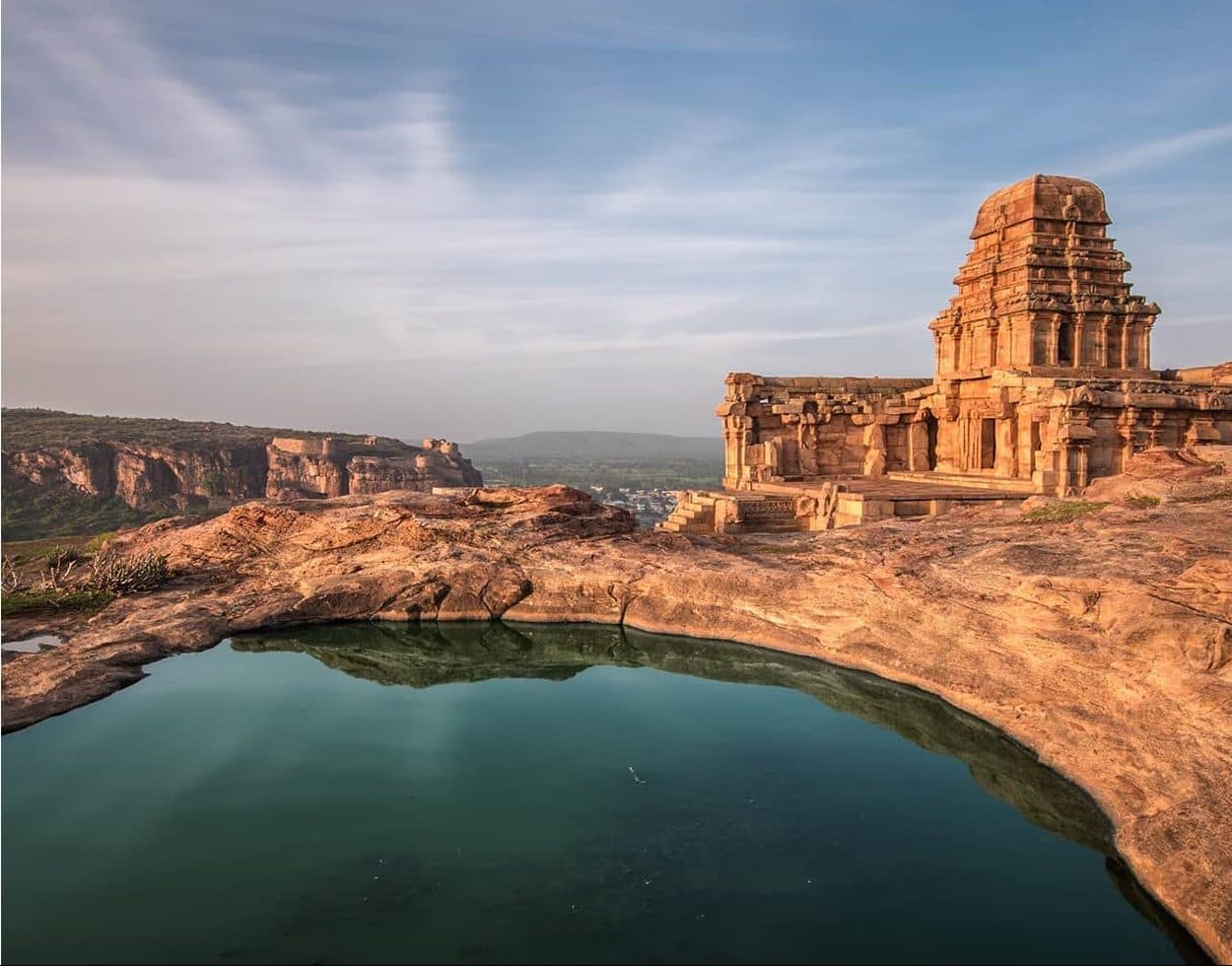
Imagine standing at the foot of a sandstone cliff as the evening sun turns everything rust-red and gold. Ancient carvings peer down at you from 1,500-year-old rock faces. A still lake reflects the silhouette of medieval temples. This is Badami, Karnataka, a town that wears centuries of history as naturally as the cliffs wear their ochre colour.
Tucked into the Bagalkot district of northern Karnataka, Badami served as the capital of the powerful Chalukya dynasty from the 6th to the 8th century AD. Known then as Vatapi, this compact town became the cradle of a temple-building tradition that would shape Indian architecture for generations. Today, Badami sits at the heart of one of South India’s most rewarding heritage circuits, drawing travellers who want more than a postcard stop; they want to feel history beneath their fingertips.
Whether you travel for architecture, spirituality, photography, or simply the thrill of discovering something India has not fully marketed yet, Badami delivers on every count.
Badami Cave Temples
The Badami cave temples are the undisputed star of any visit to the town. Carved directly into the soft red sandstone of a towering cliff face, these four rock-cut sanctuaries date back to the late 6th century and represent some of the earliest surviving examples of Hindu temple architecture in the Deccan.
Chalukyan king Mangalesha completed the main complex between 578 and 610 AD. Artisans chiselled each cave from the living rock, no bricks, no mortar, just patient craftsmanship and a deep religious vision. The result is a UNESCO World Heritage Site candidate that continues to stun visitors who stumble upon it, expecting something far smaller.
Cave 1 – The Dance of Shiva
Cave 1 is the oldest of the four and the first you encounter on the climb. Enter, and the first thing you see is an 18-armed Nataraja, Shiva in his cosmic dancing form, rendered in breathtaking detail across the cave wall. The sculptors captured over 80 different dance postures in this single panel, a feat that art historians still marvel at. The cave also houses carvings of Ardhanareeshvara, Mahishasura Mardini, and a serpent-adorned ceiling that sets an awe-inspiring tone for what follows.
Cave 2 – Vishnu in His Avatars
Sixty steps up from Cave 1, Cave 2 shifts devotion to Lord Vishnu. The defining image here is Trivikrama, Vishnu striding across the three worlds in three giant steps. Look up, and you will find ceiling panels depicting Brahma, Vishnu, and Shiva in the same frame, a rare theological statement carved in stone. The Varaha (boar) avatar panel on the wall draws particularly sharp gasps from first-time visitors for its sheer scale and precision.
Cave 3 – The Crown Jewel
Cave 3 is the largest, most elaborate, and arguably most beautiful of the quartet. It stands as a masterclass in blending the northern Nagara and southern Dravidian architectural styles, a signature achievement of the Chalukya school. The walls carry reliefs of Vishnu as Anantashayana (reclining on the serpent Ananta), Harihara (the combined form of Shiva and Vishnu), and Narasimha (the man-lion avatar). Some of India’s earliest surviving fresco paintings also survive on the ceiling here, faded but unmistakable. The panoramic view of Agastya Lake and the town below from Cave 3’s pillared veranda is alone worth the climb.
Cave 4 – Jain Serenity
Cave 4 shifts the mood entirely. Dedicated to Jainism and its Tirthankaras, this cave exudes quiet contemplation. A serene image of Mahavira anchors the sanctum, flanked by carvings of Padmavathi and other Tirthankaras. Compared to the kinetic energy of the Hindu caves, Cave 4 feels meditative, a testament to the Chalukyas’ architectural patronage across religious traditions.
Quick Visitor Info
| Detail | Information |
| Timings | 6:00 AM – 6:00 PM (all days) |
| Entry Fee (Indians) | ₹40 |
| Entry Fee (Foreigners) | ₹600 |
| Best Time to Visit | Early morning or late afternoon (golden light on sandstone) |
| Time Needed | 2 to 3 hours for all four caves |
Badami Fort
Most visitors come to the caves. Fewer make the climb to Badami Fort, and that is precisely why you should. Perched on the northern hill that overlooks the town, the fort rewards its visitors with sweeping views that no postcard can replicate.
The Chalukyas built the original fortifications, but subsequent rulers, including the Rashtrakutas, the Adil Shahis, and finally Hyder Ali and Tipu Sultan, each left their mark. Tipu’s cannon, still positioned near Cave 2’s stairway, stands as one of the more unexpected relics you will encounter on the climb.
Inside the fort walls, you will find large stone granaries that once supplied an entire royal capital, ancient cisterns, a Buddhist cave, and the elegant Malegitti Shivalaya temple, considered one of the oldest temples in Badami. Built in the Dravidian style without any mortar, the temple sits on a rocky summit and has survived both time and sieges with remarkable composure. The nearby Upper Shivalaya temple still has friezes depicting legends of Lord Krishna.
The trek to the fort takes about 30 to 45 minutes and involves uneven stone paths; wear sturdy footwear. There is no separate entry fee for the fort; your cave temple ticket covers the climb.
Top Places to Visit in Badami
Beyond the caves and the fort, Badami offers a handful of sites that complete the experience.
Agastya Lake
This ancient man-made lake sits directly below the cave temples and reflects the sandstone cliffs in its calm surface. The Bhutanatha temples line its northern banks, a cluster of sandstone shrines dedicated to Shiva that date back to the 7th century. At sunset, the light on the lake and the cliffs creates one of the most photogenic scenes in Karnataka. Boats are available for a gentle ride across the water.
Badami Archaeological Museum
Located near the cave complex entrance, this museum houses sculptures, inscriptions, and artefacts recovered from the surrounding region. It fills in the historical gaps that even the caves cannot tell you. Note: the museum stays closed on Fridays.
Banashankari Temple
About 5 km from Badami town, this temple dedicated to Goddess Banashankari draws both pilgrims and architecture enthusiasts. If your visit coincides with the annual Banashankari Devi Jatra fair (held in January or February), expect enormous crowds and a festival atmosphere that feels genuinely ancient.
Things to Do in Badami
Badami is not a passive destination. Here is how to make the most of it:
- Climb all four cave temples and take your time reading the carvings; each panel tells a story that rewards patience.
- Trek up Badami Fort at sunrise for unobstructed views of the town waking up.
- Take a boat ride on Agastya Lake, especially in the late afternoon when the water turns golden.
- Watch the sunset from the cliff viewpoint near the fort, the sandstone glows in spectacular shades of amber and rust.
- Rock climb the red sandstone cliffs. Badami has attracted climbers from across India for its technically interesting routes. Local guides can help beginners get started safely.
- Photograph the Bhutanatha temple reflections at dawn, before the tour groups arrive.
- Browse the local market near the bus stand for handloom textiles and regional produce.
Day Trips & Nearby Excursions
Badami sits at the centre of one of the densest heritage clusters in Karnataka. Plan at least one day for the surrounding circuit.
Pattadakal – 21 km from Badami
A UNESCO World Heritage Site and the ceremonial capital of the Chalukyas, Pattadakal hosts a remarkable group of 8th-century temples that blend northern and southern architectural styles in a single complex. The Virupaksha Temple here served as the template for the Kailasa Temple at Ellora. Give it 2 to 3 hours.
Aihole – 36 km from Badami
Often called the ‘cradle of Indian architecture’, Aihole contains over 125 ancient temples spread across the town and its fields. The Durga Temple and Lad Khan Temple stand out for their experimental early Chalukyan designs. Allow half a day if you want to explore properly.
Mahakuta – 14 km from Badami
A quieter stop that most itineraries skip, Mahakuta offers a group of temples built around a natural spring and tank. The site feels contemplative and sees far fewer tourists than the main circuit, making it ideal for unhurried exploration.
Is Badami near Hampi? Yes, Hampi lies approximately 140 km to the southeast, making it a feasible next stop on a longer Karnataka heritage road trip, though not a practical day trip.
How to Reach Badami
By Air
The nearest airport is Hubballi (Hubli), located about 105 km from Badami. Several airlines operate daily flights to Hubli from Bangalore, Mumbai, and Hyderabad. From Hubli, hire a taxi for a 2-hour drive to Badami.
By Train
Badami has its own railway station with direct train connections to Bangalore (overnight trains take around 10 to 11 hours), Hubli, Bijapur, and Goa. The Badami Express and several other trains serve the route regularly.
By Road from Bangalore
Badami sits approximately 450 km from Bangalore via NH67. Driving takes around 7 to 8 hours and passes through Haveri and Hubli. KSRTC operates overnight buses from Majestic Bus Stand in Bangalore to Badami, a convenient and affordable option that lands you in town by morning.
Best Time to Visit Badami
October to February is the ideal window for visiting Badami. Temperatures stay comfortable (18°C to 28°C), the light is soft and golden, and walking the cave steps does not feel like a punishment. The heritage sites feel most alive in this period.
March to May brings intense heat, temperatures regularly climb above 40°C, which makes the stone steps and open cliff walks unpleasant. If you must visit in summer, start by 7 AM and finish by 11 AM.
June to September brings the monsoon. The caves stay accessible, the cliffs turn dramatically lush, and the lake fills beautifully. However, some paths grow slippery and sudden downpours can interrupt plans. Travel with flexibility and waterproof footwear.
Suggested Itineraries
1-Day Itinerary:
- 7:00 AM – Cave Temples (Caves 1 to 4, allow 2.5 hours)
- 10:00 AM – Archaeological Museum
- 11:30 AM – Agastya Lake boat ride and Bhutanatha Temple
- 1:00 PM – Lunch at a local restaurant near the bus stand
- 2:30 PM – Badami Fort trek and Malegitti Shivalaya
- 5:30 PM – Sunset from the cliff viewpoint
2-Day Itinerary:
- Day 1 – As above, including evening at the Bhutanatha temple waterfront
- Day 2 – Morning – Drive to Mahakuta (14 km) for the spring temple complex
- Afternoon – Continue to Pattadakal (21 km) for the UNESCO temple group
- Late Afternoon – Drive to Aihole (36 km) for sunset at the Durga Temple
Local Food & Cuisine
North Karnataka cooking is hearty, spiced, and built around jowar (sorghum). Badami does not disappoint on this front. Look for jowar rotti served with ennegayi (stuffed brinjal curry) and a peanut-coconut chutney that carries a gentle heat. Local dhabas near the bus stand offer this combination at honest prices. For breakfast, try the girmit, a tangy puffed rice salad that locals eat throughout the day. Most hotels in town also offer thalis that rotate with the season.
Conclusion
Badami does not ask you to choose between history, beauty, and adventure; it gives you all three in one compact, unhurried town.
What makes Badami particularly special is how alive it still feels. Plan at least two days, one for the town itself and one for the Pattadakal–Aihole circuit. Visit between October and February for the best weather and light. Arrive early at the caves before the tour groups do. And when you stand on that cliff at sunset watching the sandstone turn gold, you will understand why the Chalukyas chose this extraordinary place to build their capital.
FAQs
What is Badami famous for?
Badami is famous for its four rock-cut cave temples carved into red sandstone cliffs, dating back to the 6th century. The town was the capital of the Chalukya dynasty and is a landmark site in the history of Indian temple architecture.
How many caves are there in Badami?
There are 4 main cave temples in Badami. Caves 1, 2, and 3 are dedicated to Hindu deities (Shiva and Vishnu), while Cave 4 is a Jain temple dedicated to Mahavira. A fifth cave with 27 rock carvings was discovered in 2013, about 500 metres from the main complex.
What is the entry fee for Badami Cave Temples?
As of the latest information, the entry fee is ₹40 for Indian nationals and ₹600 for foreign visitors. Fees are subject to change; verify at the ticket counter before entering.
What are the timings of Badami Cave Temples?
The cave temples are open every day from 6:00 AM to 6:00 PM, including weekends and public holidays. The best time to visit is early morning or late afternoon for ideal light conditions and fewer crowds.
How to reach Badami from Bangalore?
Badami is approximately 450 km from Bangalore. You can drive via NH67 in about 7 to 8 hours, take an overnight KSRTC bus from Majestic Bus Stand, or board one of the direct overnight trains such as the Badami Express.
How many days are enough to explore Badami?
One full day covers all the major sites in Badami town, the cave temples, the fort, and Agastya Lake. Plan two days if you want to include Pattadakal and Aihole.
What is the best time to visit Badami?
October to February offers the most comfortable weather for sightseeing. Temperatures stay mild, the sandstone catches beautiful winter light, and the cave steps are manageable.
Is Badami near Hampi?
Badami is approximately 140 km northwest of Hampi and a distance of 3 hour drive.
What are the nearby places to visit from Badami?
The main nearby attractions are Pattadakal (21 km), a UNESCO World Heritage Site; Aihole (36 km), known as the cradle of Indian architecture; and Mahakuta (14 km). All three make an excellent day-two circuit.
Is there an entry fee for Badami Fort?
Badami Fort does not charge a separate entry fee. Your cave temple ticket covers access to the fort area as well.