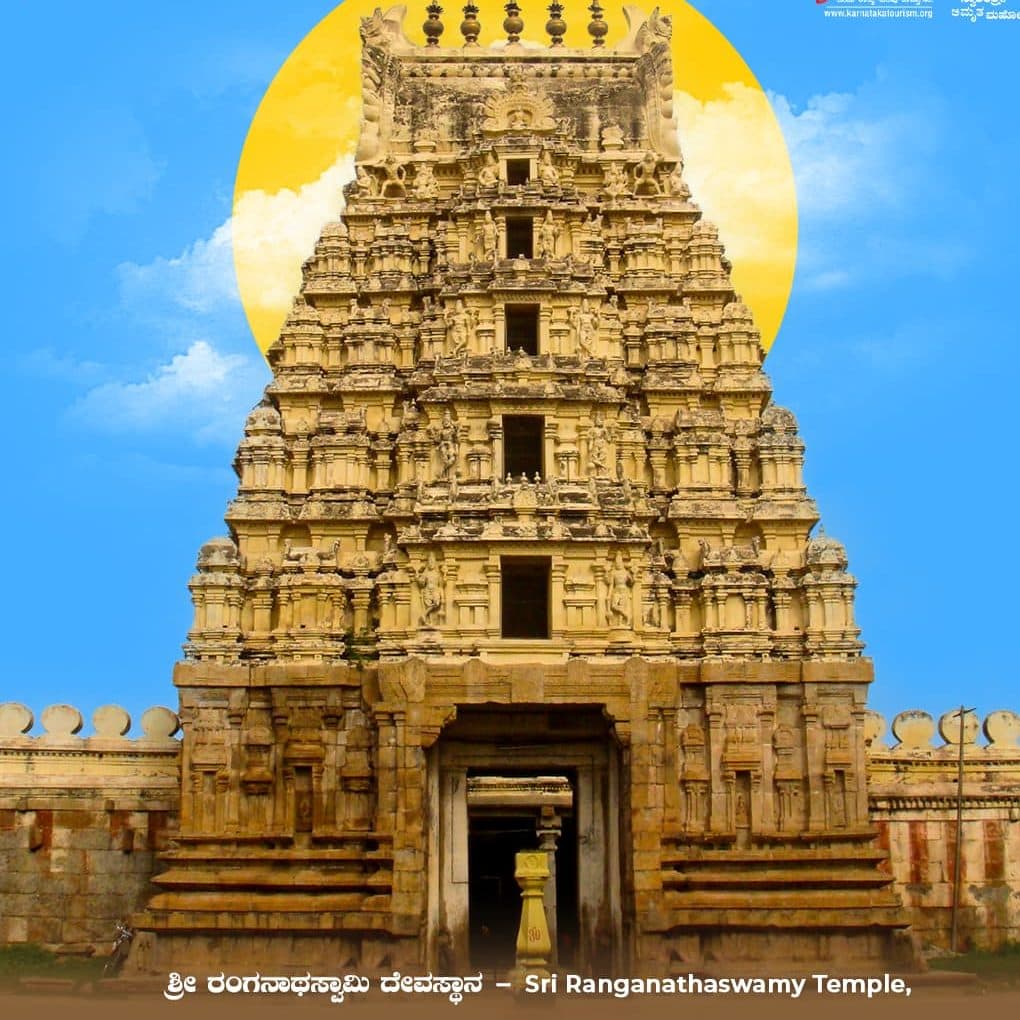
Just 15 km north of Mysuru lies Srirangapatna, a magnificent river island town entirely enclosed by the sacred Cauvery River. This unique destination blends profound spiritual heritage with some of the most dramatic military history in South India. Over the centuries, Srirangapatna has served as a powerful fortress capital for the Ganga Dynasty, the Vijayanagara Empire, the Wadiyars of Mysuru, and the legendary rulers Hyder Ali and Tipu Sultan. Every stone corridor, massive fort wall, and river ghat here tells a story of royalty, betrayal, and ultimate courage.
The Sacred Etymology: Why Srirangapatna?
The town derives its name from the magnificent 9th-century Sri Ranganathaswamy Temple that anchors the island. As the Cauvery River flows east from the Western Ghats, it creates three distinct islands dedicated to Lord Ranganatha (the reclining form of Lord Vishnu). Srirangapatna is revered as Adi Ranga (the first island), Shivanasamudra as Madhya Ranga (the middle island), and Srirangam in Tamil Nadu as Antya Ranga (the final island). Visiting Adi Ranga on this island is considered highly auspicious, drawing millions of pilgrims seeking spiritual liberation.
Srirangapatna Location & How to Reach
- Location: Srirangapatna Taluk, Mandya District, Southern Karnataka.
- Nearest City: Mysuru (~15 km) | Bengaluru (~125 km)
- By Road: Srirangapatna sits right on the bustling Bengaluru-Mysuru 10-lane Expressway (NH-275). Every KSRTC bus traveling between Bengaluru and Mysuru stops at the Srirangapatna highway junction, making it incredibly accessible.
- By Train: Srirangapatna Railway Station (S) connects seamlessly to regular passenger and express trains running daily along the Bengaluru-Mysuru rail corridor.
- By Air: The nearest domestic airport is Mysuru Airport at Mandakalli, roughly 25 km away. For international travelers, Kempegowda International Airport in Bengaluru is the closest global gateway.
The Sri Ranganathaswamy Temple Complex
The iconic Sri Ranganathaswamy Temple stands as the central crown jewel of the island. It is one of the largest and most architecturally significant temples in Karnataka, showcasing a spectacular evolutionary mix of Hoysala, Vijayanagara, and Dravidian styles. The Ganga Dynasty laid the foundational core of the temple in 894 AD, while later Hoysala and Vijayanagara monarchs expanded the grand inner pillared mandapas and carved the beautiful external gateway gopuram. Inside the inner sanctum, visitors witness the majestic idol of Lord Vishnu reclining peacefully upon the coils of the multi-headed serpent, Adi Shesha.
Essential Visitor Information
| Detail | Information |
| Temple Timings | Open daily from 6:00 AM to 1:00 PM and from 4:00 PM to 8:00 PM. |
| Dress Code | Traditional and conservative clothing. Shorts and sleeveless tops are discouraged. |
| Entry Fee | General entry is free for all. Special quick-darshan lines are available via nominal paid tickets inside. |
| Photography | Permitted outside in the courtyard, but strictly prohibited inside the active inner sanctum. |
Best Time to Visit Srirangapatna
- Peak Season – October to March: The winter weather is beautifully pleasant and cool, making it ideal for walking around the sprawling open-air fort ruins and palaces.
- Monsoon Season – July to September: When the Krishna Raja Sagara (KRS) dam opens its gates, the Cauvery River surges beautifully around the island fortress, creating a dramatic, water-locked spectacle.
- Festival Windows: High crowds gather during Mahalaya Amavasya and Sankranti for ritual holy dips along the river banks.
Places to Visit In & Around Srirangapatna
1. Tipu Sultan’s Fortress & Historical Monuments
Srirangapatna was the capital of the ‘Tiger of Mysore’, Tipu Sultan. The island retains remarkable remnants of his military stronghold:
- Dariya Daulat Bagh: This stunning Summer Palace is built entirely of premium teakwood. Its interior walls feature rich, detailed frescoes depicting historic Anglo-Mysore wars and royal portraits.
- Gumbaz: An elegant Persian-style mausoleum holding the tombs of Tipu Sultan, his father Hyder Ali, and his mother Fatima Begum, surrounded by cypress gardens.
- Colonel Bailey’s Dungeon: A chilling underground fortress prison where Tipu Sultan chained captured British officers during the wars.
- The Death Place Marker: A modest stone marker indicating the exact spot where Tipu Sultan was killed by British forces during the final Siege of Srirangapatna in 1799.
2. Sri Nimishamba Temple
Located just 2 km from the main town in Ganjam village, this highly revered temple sits right on the edge of the Cauvery River. Devotees firmly believe that the presiding deity, Goddess Nimishamba, clears all obstacles and worries within a ‘Nimisha’ (minute).
3. Ranganathittu Bird Sanctuary
Situated 5 km from the island, this is Karnataka’s largest bird sanctuary. Formed by a cluster of small rocky islets in the Cauvery River, it hosts thousands of migratory birds from Siberia, Australia, and North America. Guided boat rides offer close-up views of crocodiles and nesting birds.
Local Delicacies & The GI-Tagged Heritage
The agrarian climate of the Mandya-Mysuru border gives Srirangapatna an exceptional culinary and agricultural profile:
- Mysore Mallige (Jasmine – GI Tag No. 37): Cultivated heavily in the fertile alluvial soils of Srirangapatna and the adjacent Ganjam village, this local jasmine variety holds an official Geographical Indication tag. It is world-famous for its incredibly strong, volatile fragrance and long-lasting shelf life.
- Organic Jaggery & Fresh Sugarcane Juice: Srirangapatna lies in the heart of Karnataka’s sugarcane country. The highway is lined with traditional Alemanes (jaggery-making rustic units) where you can sample hot, fresh organic jaggery and cold sugarcane juice spiced with ginger and lemon.
- Traditional Fish Fry: Due to the river ecosystem, local eateries along the riverbanks serve fresh, spiced, catch-of-the-day river fish fry prepared with authentic local masalas.
Tips & Safety Guidelines for Travelers
- River Safety: The Cauvery River currents around the island are notoriously swift and unpredictable. Avoid swimming or stepping into non-designated areas, and strictly restrict your holy dips to the main concrete bathing steps at the Sangam.
- Hire Certified Guides: To truly understand the complex layout of the fort breaches, underground dungeons, and palace frescoes, hire only tourism department-certified guides at the monument entry points.
- Carry Cash: Keep physical cash handy for bird sanctuary boating tickets, small monument entry fees, purchasing fresh jaggery, and paying local auto fares.
Where History and Faith Converge
Srirangapatna rewards travelers who appreciate deep history and spiritual resonance. It is a rare place where a grand temple of immense antiquity stands alongside the battlefields that shaped the destiny of modern India. From the soothing river breeze of the Cauvery to the intricate woodwork of royal palaces, Srirangapatna stands as a living, unmissable monument to Karnataka’s vibrant soul.
FAQs
Why is Srirangapatna considered an island?
Srirangapatna is a river island because the Cauvery River splits into two streams upstream, completely loops around the town area, and converges again downstream.
What is the significance of Adi Ranga?
Adi Ranga refers to the first of the three sacred island temples of Lord Ranganatha along the Cauvery River. Srirangapatna is the first, followed by Madhya Ranga in Shivanasamudra, and Antya Ranga in Srirangam.
Are there entry fees for the monuments in Srirangapatna?
The main Sri Ranganathaswamy Temple is free to enter. Historical monuments like Dariya Daulat Bagh and the Gumbaz require a nominal entry ticket managed by the Archaeological Survey of India (ASI).